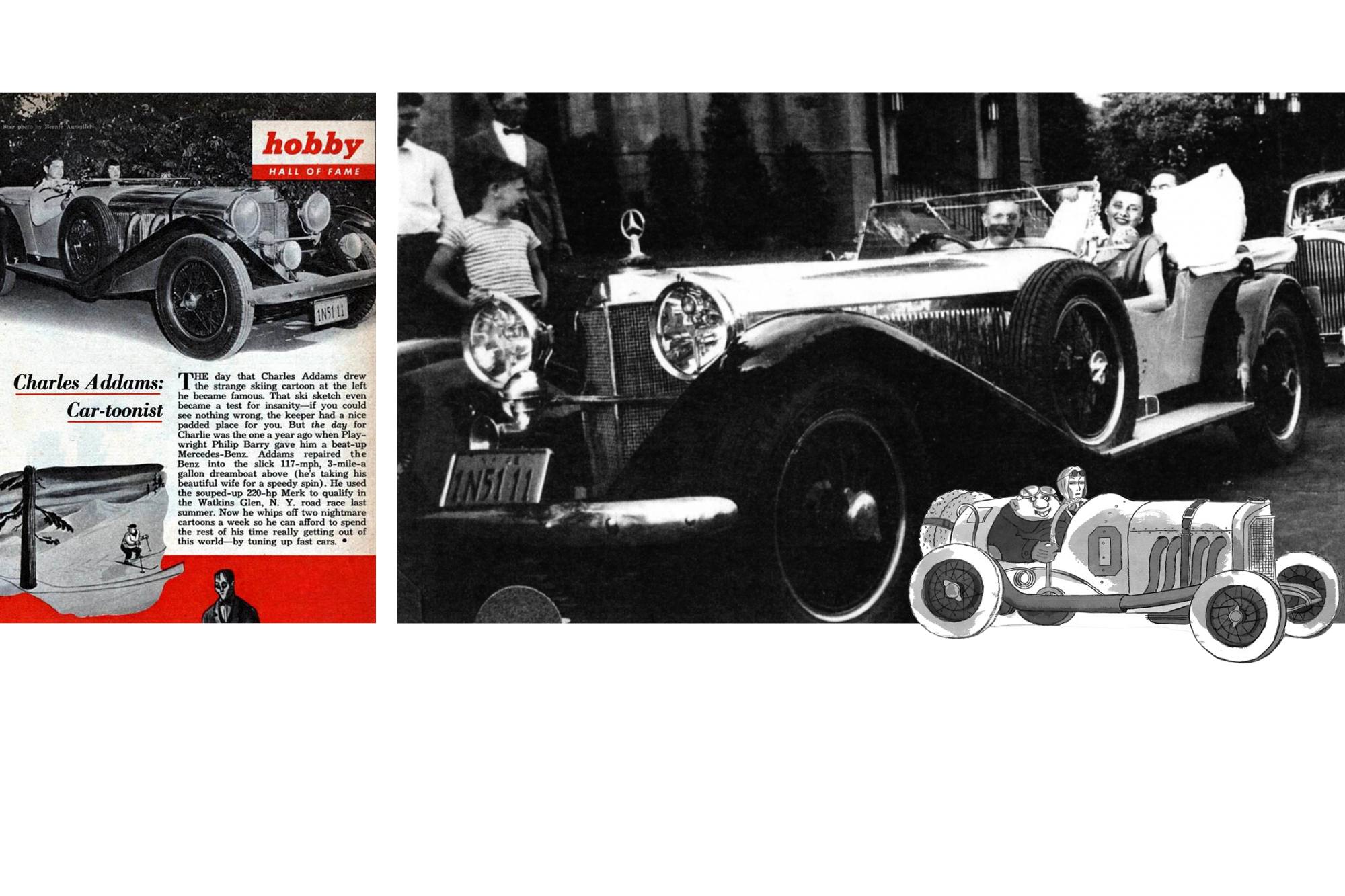
1927 Mercedes-Benz 680 S Sindelfingen Sports Tourer
While a merger between Daimler-Motoren-Gesellschaft and Benz & Cie. had been on the cards for some time by the mid-1920s, it would take Germany’s economic crisis for there to be a real urgency for the brands to unite. With their survival at stake, a deal was agreed on 28th June 1926 and Daimler Benz AG (Aktiengesellschaft) was established. Products of the new merger would be named to honour the most famous aspects of each partner: Mercedes from Daimler, and Benz for the man who patented the first motorcar in 1886.
The first all-new design from ‘Mercedes-Benz’ would be a sports car, the appropriately named Modell S. It has become known by several names since its creation: Typ S, S-Type, 680 S and the 26/120/180. All of these is the same car and while the first two are obvious variations of the theme, ‘680 S’ referred to the capacity of the supercharged straight-six engine, which had grown half a litre over the previous Model K to a whopping 6.8-litres. That final numerical moniker is a little more cryptic; ‘26’ was the Model S’s tax horsepower rating, a figure equated from cylinder specifications to determine the car’s road tax bracket, and the ‘120’ & ‘180’ figures were the actual bhp figures in unblown and supercharged states. To most ears, 680 S sounds most exciting and so we’ll stick with that.
The 680 S was first full design completed by technical director Ferdinand Porsche, who had been a pre-merger employee of Daimler. While dimensionally similar to the previous Model K, or 630 K, the 680 S was dramatically lower and immediately more purposeful as a sports car. To prove that the 680 S had the goods as well as the looks, Mercedes -Benz entered two of the earliest examples, in full Rennsport trim, into the Eifelrennen on 18th June 1927 – the first motorcar race held on the new Nürburgring. The pair romped home to an easy 1-2.
Just a few weeks later on 6th July, an order was placed for the car you see here via the Mercedes-Benz main dealer in Berlin. ‘Win on Sunday, sell on Monday’ was clearly in full effect… we’ll never know for sure if Caracciola’s victory inspired Richard Klinger to order his new 680 S, but it is exciting to think that he could have been a spectator at the race. The correspondence address on the order ledger gives that of Klinger’s thriving engineering business ‘Maschinen-und Metallwarenfabrik Ges.m.b.H’, which is still run by his descendants today as Klinger GmbH.
Commission No.34904 was fulfilled promptly, with the early Model S chassis 35222 equipped with right-hand drive and engine number 60404. Sports Tourer coachwork with number 917240 was selected from Mercedes-Benz’s in-house Sindelfingen outfit, which closely matched the design of the factory Rennsport racers, and is believed to have been originally painted dark green. A curious choice, given that national racing colours were still very much observed at the time, but an equally tantalising option for a future owner to consider.
The 680 S was registered to Klinger on 3rd August 1927 and would remain in his ownership until 1932, when it was sold to famed playwrite Philip Barry; the first of several great creatives to be seduced by its rakish charm. Barry enjoyed the Mercedes-Benz on the French Riviera, where his ‘lost generation’ circle of friends included the likes of Pablo Picasso, F. Scott Fitzgerald and Fernand Léger. It’s claimed that the car ferried them all from one jaunt to the next. Phillip Barry and his wife Ellen returned to their native United States in 1934, settling in Hobe Sound, Florida. The 680 S accompanied them and was kept as a “monument to our youth”, in their own words.
In 1947 the Mercedes-Benz passed to Barry’s friend and cartoonist Charles Addams and there are reports that the car may even have been a gift. Addams was a known car fanatic, owning several Bugattis, an Alfa 8C 2300 and a 1923 Mercedes Indy racer, and took to lengthening the rear body slightly to make the rear bench seat more comfortable. But the 680 S was not relegated to being a mere cruiser, as Addams in fact competed with it at the inaugural road race at Watkins Glen, and even chalked up a win in 1951 at Bridgehampton’s SCCA races. Although Addams would sell the 680 S in 1952, it became indelibly linked to the Addams Family creator, and was featured in articles about him in the likes of Life and Harpers Bazaar magazines.
Barclay Morrison was the man to take on what he called ‘The Beautiful Beast’ from Addams. A Mercedes-Benz Club member and perfectionist, Morrison had the car restored and it would be his pride and joy until 1960. His strict requirements for the 680 S’s next owner were met by a Mr Mark Tutti, who in turn would keep the car until 1968. Robert A. (Bob) Day, he of Superior Oil’s Keck-Day family, was next to add his name to the 680 S’s roll call before selling to yet another creative - Hollywood producer John Calley, whose credits include The Exorcist, Clockwork Orange and Superman.
Calley was a self-made success and his blockbusters allowed him to indulge in his passion for the vintage Mercedes-Benz, entrusting none other than Hill & Vaughn to complete a full restoration in the early 1970s. The company of 1961 Formula One World Champion Phil Hill carried out a full mechanical overhaul, as well as reversing the modifications made during Addams’ ownership, and finished the car in a taupe-over-red colour scheme similar to the striking 680 S bodied by Saoutchik. In 1975, shortly after the restoration work had been completed, the 680 S was acquired by Japanese industrialist and inventor Yoshiyuki Hayashi, whose staggering collection was accumulating apace.
In 1995, some twenty years later, Bernie Ecclestone acquired the entire Hayashi collection. The F1 supremo would keep the 680 S for a year before selling via a Brooks auction, held appropriately at the old Mercedes-Benz Museum in Stuttgart, to Etienne Veen. This noted Dutch collector brought the car back to the UK, where it was registered and remained for the next 17 years, enjoying this eminently capable motorcar on events like the Mille Miglia Storica.
In 2013, this Teutonic tourer joined the esteemed collection of the current owner and was repatriated to Germany for the first time since 1932. It survives today having retained its original matching-numbers engine, chassis and Sindelfingen bodywork.
The 1920s ended as they had begun, with yet another financial crisis, and the fact that just 128 Mercedes-Benz S-Types were built in total is evidence of the dire economic reality. With even fewer having survived to approach their centenary, a 680 S today is a rare commodity and it is not often that one becomes available, let alone one with a fully documented and known history. A commanding presence in any collection, the 680 S does not need to be driven to be enjoyed, but the world is an infinitely more exciting place when viewed from behind its loping bonnet… especially when the supercharger is engaged.

Fiskens, 14 Queens Gate Place Mews, London, SW7 5BQ
|
Phone: +44 (0)20 7584 3503
© 2026 FISKENS Ltd. Registered Company Number: 3382047
Terms of Use | Privacy and Cookies Policy Site by racecar